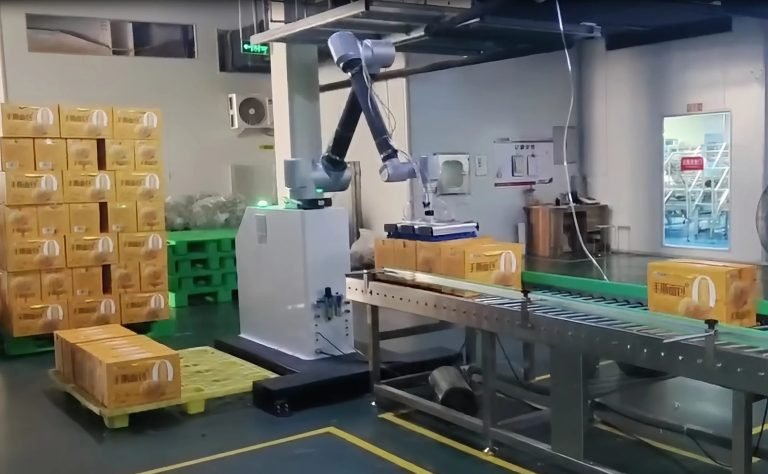
Start With Your Numbers, Not the Robots
Payload and reach matter, but they are not the first question. The numbers that decide whether a palletizing robot pays for itself are much simpler:
- Cartons (or bags) per shift — the real average, not the peak on a good day.
- People assigned to the palletizing station across all shifts, including the relief operator who covers breaks and holidays.
- Number of product formats that share the same palletizing area during one week.
A factory running three shifts with two operators on the station is not paying for two people — it is paying for six full-time positions plus recruitment and training every time one of them leaves. That is the figure a robot has to beat, and on most three-shift lines it is not a close call.
Four Signals That Automation Is Overdue
These are the four symptoms our engineers hear most often in the first phone call. Any two of them together is usually enough to justify a proper study.
1. Labour turnover in the palletizing station
Manual palletizing is repetitive, physically heavy and, frankly, boring. When turnover on that station is higher than the plant average, the cost is not only the salary — it is the constant retraining, the quality variation between shifts, and the supervisor time spent covering gaps.
2. Manual lifting limits and injury risk
Cartons above roughly 15–20 kg stacked at shoulder height are a strain injury waiting to happen. A single reported back injury typically costs more in lost days, insurance and overtime cover than a full year of robot maintenance. This is often the argument that convinces management faster than the labour calculation.
3. Capacity peaks you cannot staff
If the line can fill 1,400 cartons an hour but your palletizing station can only clear 1,100, the bottleneck is not the filler — it is the end of the line. Seasonal peaks make it worse: you either hire temporary staff who need supervision, or you cap production and disappoint customers.
4. Pallet consistency and product damage
Manual stacking quality drifts through the shift. By the third hour, pallet patterns get loose, layers lean, and stretch wrapping has to compensate. Feed those pallets into a warehouse racking system and the damage rate becomes visible very quickly.
A 60-Second Self-Assessment
Score your own line against the table below. Two or more “time to automate” answers means the study is worth doing.
| Indicator | Comfortable today | Time to automate |
|---|---|---|
| Shift pattern on the palletizing station | 1–2 shifts | 3 shifts, incl. weekend |
| Operator turnover (12 months) | Under 15% | Over 25% |
| Unit weight handled manually | Under 12 kg | 15 kg and above |
| Product formats sharing the cell | 2–4 stable formats | 6+ formats, or frequent new launches |
| Pallet reject / re-stack rate | Under 0.5% | Over 2% |
| Space available for a cell | Tight, no free corner | 7–15 m² can be released |
What It Costs — and What It Returns
A complete palletizing cell is not just the robot. Budget for the whole package:
- Robot arm + controller — sized by payload, reach and cycle time.
- Gripper or vacuum tooling — the part that decides whether the cell can handle all your cartons.
- Infeed conveyor and pallet dispenser — so the robot never waits for product or pallets.
- Safety guarding, interlocks and CE documentation — non-negotiable in most export markets.
- Integration, programming and operator training — where cheap projects quietly become expensive ones.
Compare that with the cost of six positions, the overtime to cover a peak season and the pallets you currently re-stack by hand. On a single-shift operation the maths is much tighter — which brings us to the honest part.
When a Robot Is the Wrong Answer
If your operators rebuild the pallet pattern from scratch every twenty minutes, a robot will not fix your problem — standardising the pattern will. Automate a chaotic process and you simply get chaos at a higher speed.
OK Engineering Team
A palletizing robot is usually the wrong choice when:
- Product formats change dozens of times a day with no repeatable pattern.
- Volumes are low and seasonal — a manual station with better lifting aids is cheaper.
- The bottleneck is actually upstream (filling, sealing, labelling) and pallets simply back up.
- No one on site can own the equipment after commissioning.
Rule of thumb
Automate the station that limits your output and hurts your people — not the station that looks most impressive in a trade show video.
From “Maybe” to a Line Layout
If two or more signals apply, this is the sequence we recommend to customers before any money is committed:
- Record 60 seconds of video of the palletizing station at normal speed, plus a sketch of the workshop with dimensions marked.
- Send the product list — carton or bag size, weight, layer count and required pallet height.
- Ask for a cycle-time calculation, not a brochure. Our engineers return a layout drawing with cycle time, reach envelope and the number of operators needed after automation.
- Test the tooling before shipping. For difficult packs (film bags, unstable trays) a sample run on our factory line removes most of the risk.

Conclusion
Palletizing automation is not a technology decision, it is an arithmetic one. Count the positions the station consumes across all shifts, add the cost of injuries, re-stacks and peak-season overtime, then compare that with a cell that runs the same speed all day without a coffee break.
If the arithmetic does not work yet, keep the manual station and fix the pattern problem first. If it does, the study costs you nothing but a video and a drawing — and it is the only way to compare real quotations.
Frequently Asked Questions
For standard cartons, a single palletizing robot typically handles 8–12 pieces per minute; for bagged products such as 25–40 kg fertilizer bags, 8–10 pieces per minute. Final cycle time depends on layer pattern, gripper type, pallet height and the number of format changes per shift.
In most cases no. A floor-mounted cell with levelling pads is sufficient if the existing slab is in reasonable condition. We confirm the required floor loading — including the dynamic load of payload, pallet and tooling — in the layout drawing before shipping.
Yes, and that is usually the point. The robot stores pallet patterns in the controller, and the operator selects the format on the HMI. Changing from cartons to shrink trays normally takes a tooling change plus a recipe selection — a few minutes, not a rebuild.
No. Day-to-day operation is start, stop, recipe selection and pallet load. Programming is done during commissioning, and we train your team on the teach pendant, alarm handling and basic pattern adjustments so you are not dependent on us for routine changes.
Standard warranty is 12 months from commissioning. We supply spare-part lists with the layout drawing, provide remote support for software and alarm issues, and can quote an on-site service visit or an annual maintenance plan depending on your location.